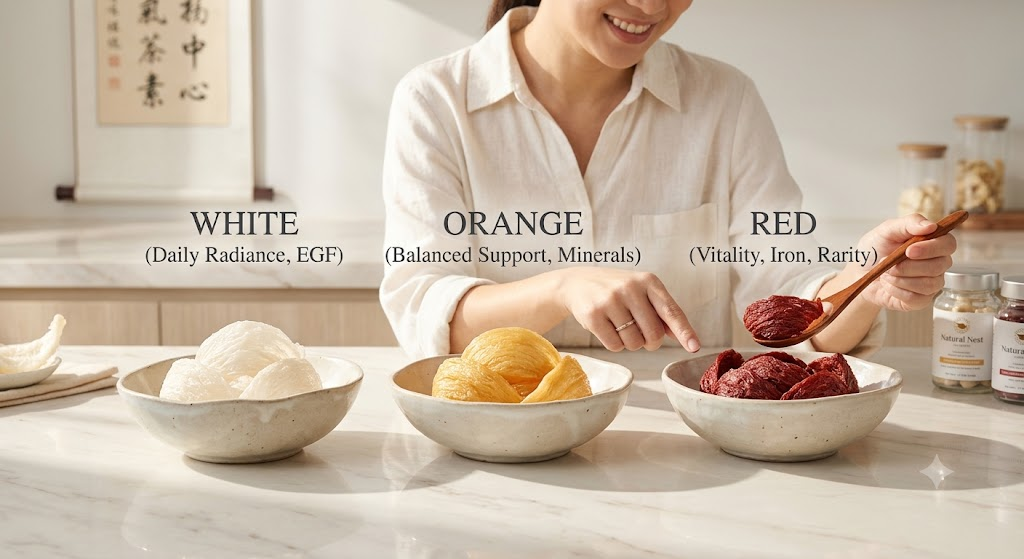
When shopping for edible bird’s nest in Singapore, you will immediately notice three primary color variations: White, Orange, and Red (often called Blood). The dramatic color difference, combined with significant price disparities, often leaves consumers asking: Which type of bird’s nest is actually best for my health?
Traditionally, the deeper the color, the more prized the nest was considered. However, modern scientific analysis reveals that while the basic nutritional foundation remains similar, the different colors arise from distinct environmental interactions, resulting in unique mineral profiles and textures. Understanding these differences will help you choose the best nest for your specific wellness goals.
Here is a scientific breakdown of White, Red, and Orange bird’s nests, clearing up common myths and highlighting their distinct benefits.
1. White Bird’s Nest: The Standard for Daily Radiance
White bird’s nest is the most common and widely recognized type, harvested primarily from the Aerodramus fuciphagus swiftlet, which builds its nest in relatively clean environments, such as purpose-built swiftlet houses.
Nutritional Profile & Texture
- Color & Texture: True to its name, this nest is off-white or light ivory. When cooked, it has the softest, most delicate, and gelatinous texture. It expands significantly during soaking and cooking.
- Key Health Benefit: White nests are prized for their exceptionally high concentration of Sialic Acid and Epidermal Growth Factor (EGF).
- Ideal For: Because it is soft and digestible, it is the classic choice for daily skin health maintainance, supporting collagen synthesis, and boosting general immune function and respiratory health. It is also an excellent option for children and elderly individuals who prefer a softer texture.
2. Orange Bird’s Nest: The Gold Standard for Balanced Support
Orange bird’s nest, often called “Golden Bird’s Nest” or “Yellow Bird’s Nest,” displays a natural hue that ranges from light orange to a deep golden yellow. This color variation is entirely natural and is not a result of bleaching or artificial dyeing.
Nutritional Profile & Texture
- Color & Texture: The golden color occurs when swiftlets build nests in environments with slightly higher humidity or specific wall minerals (like sodium or potassium) in cave systems or mature swiftlet houses. This exposure gives the orange nest a noticeably firmer, crunchier, and smoother texture than the white variety.
- Key Health Benefit: Beyond the foundational protein and EGF, orange nests offer a more balanced mineral profile, which supports overall cellular health and hydration.
- Ideal For: Its firm texture makes it suitable for long-term health maintenance, especially for individuals with demanding lifestyles who need sustained energy and comprehensive nutritional support over a softer, skin-focused tonic.
3. Red (Blood) Bird’s Nest: The Pinnacle of Vitality and Rarity
The deep crimson or ruby-red bird’s nest, colloquially known as Blood Nest, is the rarest, most expensive, and most mysterious of all the varieties. Its intense color and rarity have led to centuries of mythology.
Myth Buster: Clearing Up the ‘Blood’ Superstition
For generations, it was widely believed that the red color came from the swiftlet’s exhausted state, causing it to vomit blood during the nesting process. Modern science has categorically proven this myth false.
The true origin of the red color is environmental interaction. Cave-harvested red nests absorb minerals—specifically iron and calcium—from the humid cave walls over an extended period. Mature swiftlet house nests can also turn red due to natural chemical reactions (known as the Maillard reaction) between nitrogen and the nest proteins in highly specific environmental conditions.
Nutritional Profile & Texture
- Color & Texture: Due to the dense concentration of minerals, Red Nest has the firmest, chewiest, and most distinct texture of all three types. It takes much longer to soak and cook than white or orange nests.
- Key Health Benefit: The Red Nest’s defining characteristic is its dense mineral content, particularly Iron and Calcium. Iron is vital for blood formation, oxygen transport, and energy levels, while calcium is essential for bone density and nerve function.
- Ideal For: Its rare, mineral-dense profile is highly sought-after for deep vitality restoration. It is traditionally the preferred choice for postpartum recovery (confinement), individuals recovering from major surgery or illness, and those needing intensive energy and blood replenishment.
Conclusion: Which Nest is Best for You?
The “best” bird’s nest depends on your specific needs, preference for texture, and wellness goals.
- Choose White Nest if you prioritize soft, digestible texture and are focused on daily skincare and basic immune support.
- Choose Orange Nest if you prefer a firmer, crunchier texture and are seeking balanced nutritional support for long-term well-being.
- Choose Red (Blood) Nest if you require intensive vitality restoration, are recovering from illness or childbirth, and value the highest mineral and iron density with a chewy texture.
At Natural Nest, we offer all three varieties, guaranteed 100% natural, ethically sourced, and free from any artificial bleaching or coloring. Our detailed sorting process ensures that you receive the exact type and quality of nest you desire. Whether you choose white, orange, or red, you are investing in centuries of wellness wisdom, validated by modern biochemistry.