For centuries, edible bird’s nest has been prized across Asia for its remarkable health and skincare benefits. Rich in sialic acid, Epidermal Growth Factors (EGF), essential amino acids, and vital trace minerals, bird’s nest is widely consumed to enhance immunity, promote youthful skin, and aid prenatal and postnatal recovery.
However, when exploring premium edible bird’s nest in Singapore, you will often come across two main sourcing origins: Cave Bird’s Nest and House Bird’s Nest.
While cave nests have a long historical legacy, modern house nests have become the gold standard for purity and ethical sourcing. In this article, we compare the purity, safety, nutritional profile, and sustainability of cave nests versus house nests to help you choose the best option for your health and family.
What is Cave Bird’s Nest?
Cave bird’s nest is harvested directly from natural rock formations, limestone cliffs, and deep sea caves, predominantly in Southeast Asian regions like Sarawak, Sabah, and Indonesia.
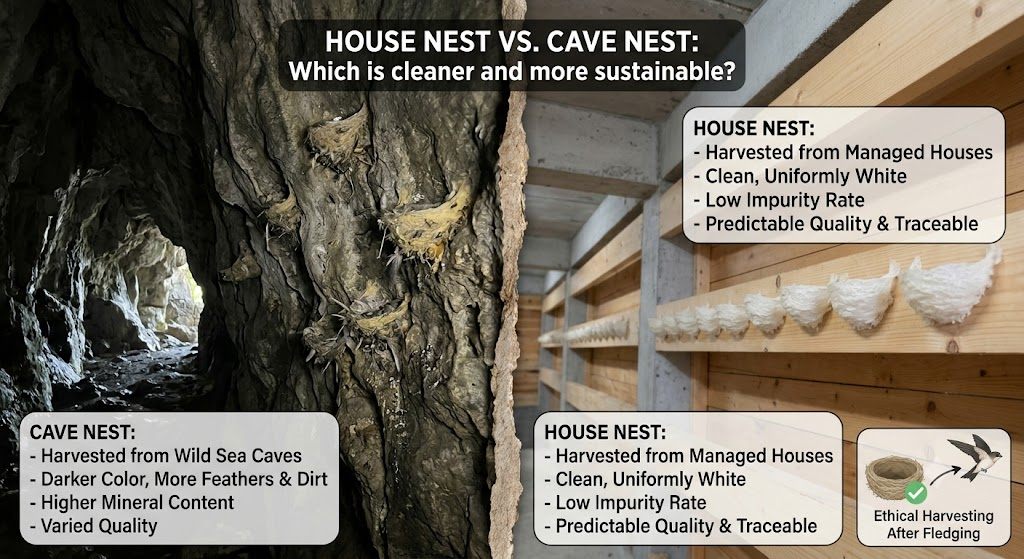
Because swiftlets build their nests on raw cave walls exposed to natural mineral runoff over time, cave nests often absorb trace elements from the rock faces, giving them a firmer texture and slightly varied coloration (ranging from deep yellow to orange or red).
The Downside of Cave Harvesting:
- Impurity & Heavy Metals: Caves are open ecosystems shared with bats and wild fauna. Nests absorb environmental pollutants, bat guano dirt, and potential heavy metals from the surrounding damp rock walls.
- Higher Contamination Risk: Raw cave nests contain a significantly higher volume of feathers, dirt, and organic debris, requiring harsh or intensive cleaning methods.
- Inconsistent Quality: Because environmental factors inside sea caves fluctuate, the texture, purity, and mineral safety of cave nests can vary wildly from batch to batch.
What is House Bird’s Nest?
House bird’s nest comes from swiftlet houses—specially designed, eco-friendly structures built to replicate the dark, humid, and safe temperature conditions of natural caves.
Swiftlets remain 100% wild and free; they fly out into the open sky each morning to forage for natural food and return to the swiftlet house at night to rest and nest. No birds are ever caged or artificially fed.
Advantages of House Bird’s Nest:
- Superior Hygiene & Purity: Managed swiftlet houses are kept clean and monitored constantly. Nests are built on smooth, food-grade wooden beams away from soil, guano, or rock face contaminants.
- Low Impurity Rate: Because house nests are harvested in clean, controlled conditions, they contain fewer feathers and minimal dirt, allowing for pure, chemical-free hand cleaning using purified water.
- Consistent Quality & Safety: Free from environmental pollutants and heavy metals, house nests offer a predictable, high-yielding texture that cooks into a smooth, silky tonic.
Sustainability: The Ethical Choice
When evaluating edible bird’s nest, sustainability and bird welfare are paramount concerns for conscious consumers.
- Cave Nest Harvesting Concerns: Wild cave harvesting often involves perilous climbs up rope ladders into unmanaged territory. Historically, over-harvesting in wild caves led to habitat disruption, broken eggs, and premature removal of nests while chicks were still inside.
- Sustainable House Nest Farming: Professional swiftlet house management follows strict ethical protocols. Harvests are meticulously timed—nests are only gathered after baby swiftlets have fully grown, learned to fly, and naturally abandoned the nest. Since swiftlets build a brand-new nest for every breeding cycle, collecting abandoned empty nests causes zero harm to the birds or their population growth.
Comparing Cave Nest vs. House Nest
| Feature | Cave Bird’s Nest | House Bird’s Nest |
| Origin Environment | Wild sea caves and limestone cliffs | Clean, temperature-regulated swiftlet houses |
| Bird Lifestyle | 100% Wild | 100% Wild (Free-flying, wild foraging) |
| Hygiene & Cleanliness | Low (High risk of bat guano, dirt, heavy metals) | High (Clean, food-safe wooden beams) |
| Purity Level | Heavy impurities; requires deep cleaning | Very Pure; low feather and debris content |
| Texture & Yield | Very hard, dense, variable expansion | Firm, delicate, high expansion yield |
| Sustainability & Welfare | Higher risk of habitat disruption | Ethical & Sustainable (Harvested after fledging) |
Final Verdict: Which Should You Buy?
While cave nests carry historical novelty and extra mineral density from rock exposure, house bird’s nests are objectively cleaner, safer, and far more sustainable.
For daily consumption, pregnancy nutrition, and family wellness, House Bird’s Nest is the superior choice. It delivers all the nourishing benefits of natural sialic acid and EGF without the risks of environmental contaminants or heavy metal absorption.
Experience Pure, Ethically Sourced Wellness with NaturalNest Singapore
At NaturalNest.sg, we prioritize safety, purity, and ethical craftsmanship above all else.
Our nests are sourced exclusively from sustainable, clean swiftlet houses. Every nest is 100% hand-cleaned with purified water, free from chemical bleaching, artificial colorings, or synthetic additives. Enjoy the authentic, rich nourishment of pure edible bird’s nest delivered straight to your home.
Discover our full range of premium dried and freshly stewed bird’s nest products today at NaturalNest.sg!